

The Tic Tac UAP and the Ocean Probe Hypothesis
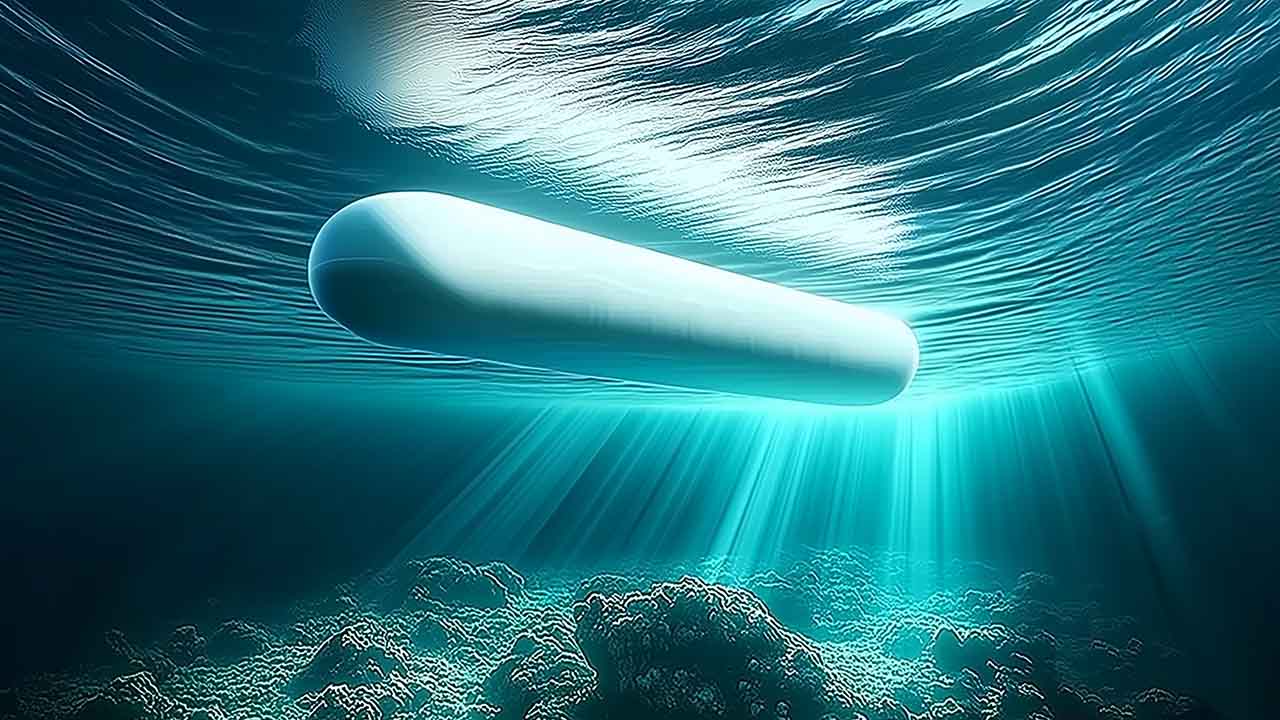

In November 2004, Navy pilots from the USS Nimitz encountered a small white “Tic Tac” above a patch of disturbed Pacific water—an object described as wingless, rotorless, cockpitless, and radically unlike a conventional aircraft. From that unresolved maritime encounter, a larger speculative question emerges: if an advanced extraterrestrial intelligence studied Earth through autonomous machines rather than crewed vessels, could the oceans serve as hiding place, factory floor, fuel reservoir, and launch environment for AI-powered von Neumann probes using seawater as an industrial feedstock?
The Nimitz Tic Tac UAP Mystery
The Nimitz encounter begins not as folklore, but as a military incident at sea. According to retired Cmdr. David Fravor’s statement to the House Oversight Committee, he was commanding officer of Strike Fighter Squadron 41 aboard USS Nimitz in November 2004 when a planned air-to-air training exercise was interrupted for real-world tasking. His flight was controlled by USS Princeton, whose operators, he said, had been observing unusual objects on the Aegis combat system for roughly two weeks, including tracks reportedly descending from above 80,000 feet to 20,000 feet.
When the pilots arrived, Fravor described a nearly perfect day: clear skies, light winds, calm seas, and no whitecaps. That is why the patch of white water stood out. Looking down, the crews saw what Fravor described as a small white Tic Tac-shaped object moving abruptly above the disturbance, with no rotors, no rotor wash, and no visible flight-control surfaces such as wings.
The most dramatic performance claims should be stated carefully. Fravor’s statement says the object appeared to react to his aircraft, climbed, rapidly accelerated, disappeared, and was then reported by the Princeton controller to have reappeared on radar near the combat air patrol point roughly 60 miles away in less than a minute. That account is central to the case, but the public record does not include the full raw sensor package needed to independently verify the object’s size, range, speed, or acceleration.
The Department of Defense officially authorized the release of three unclassified Navy videos in April 2020, including one taken in November 2004, and stated that the aerial phenomena in the videos remained characterized as “unidentified.” “Unidentified,” however, is not the same as “extraterrestrial.” NASA’s UAP study notes that UAP reports can be scientifically interesting, but eyewitness accounts alone are not reproducible and usually lack the information needed to determine provenance.
The Ocean Concealment Problem
The most important detail in the Nimitz story may not be the Tic Tac’s shape, but the place where it appeared. It was not seen descending onto a runway, hovering over a desert test range, or landing beside a visible terrestrial facility. It was seen over the Pacific, above water that appeared, at least to the witnesses, to be disturbed by something below.
The ocean is not evidence of a hidden probe system. But inside the ocean-probe hypothesis, it is the terrestrial environment that creates the fewest immediate contradictions. NOAA notes that the ocean covers about 70% of Earth’s surface, and that as of April 2026 only 28.7% of the global seafloor had been mapped with modern high-resolution technology. NOAA also notes that explorers have visually seen less than 0.001% of the deep ocean seafloor.
AARO’s FY2024 public dataset does not support a confirmed maritime or transmedium pattern. Its report says AARO received 757 UAP reports for the period it covered, with 708 in the air domain, 49 in the space domain, and none in the maritime or transmedium domains. But the same report also says AARO initiated working groups for space and maritime domains and is developing partnerships to mitigate reporting bias and improve domain awareness across space, air, and maritime environments.
That tension is exactly why the ocean matters to a speculative science story. The public record does not show an oceanic UAP infrastructure. But if a nonhuman machine intelligence wanted to observe Earth while minimizing contact, the ocean would be the obvious place to hide, to cool machinery, to move without casual detection, and perhaps to gather materials from a planet-sized chemical reservoir.
Autonomous UAP Probes, Not Crewed Craft
The classic image of extraterrestrial visitation is biological: occupants, cockpits, windows, hatches, and something recognizably analogous to aircraft. The Tic Tac account points in a different direction. A smooth white object without visible wings, rotors, exhaust, cockpit, or control surfaces is easier to imagine as a machine than as a crewed vehicle.
That distinction matters because the most plausible interstellar explorers may not be living beings at all. Self-replicating probes are a serious speculative category in space-exploration literature: spacecraft able to create copies of themselves using local resources, potentially multiplying exploration capacity. Borgue and Hein’s near-term concept study proposes only partial self-replication; it still assumes that microchips and other microelectronic components are carried by the initial probe rather than locally reproduced.
John Storrs Hall makes a similar argument from the futurist side. In the seawater-extraction transcript, when asked whether Tic Tac UAP might be nanotech self-replicating von Neumann probes, Hall answers with a “yes and a no.” If humans ever see extraterrestrial technology, he says, “by far the most likely thing” would be a von Neumann probe, something sent out in tiny pieces like an insect egg or thistle down. But he also cautions that Earth is unusual, and a probe designed for the average planet might not be optimized for this one unless it could adapt.
That caveat is essential. A machine-probe hypothesis is not a shortcut to certainty; it is a way of changing the question. Instead of asking how biological visitors would survive interstellar travel, atmospheric flight, and ocean concealment, it asks how autonomous machines might operate if they had no need for air, food, sleep, gravity comfort, or return trips.
Hall’s Artificial Seaweed
The deepest connection between Hall’s work and the ocean-probe hypothesis is not the Tic Tac itself. It is the idea that the ocean is not empty water. It is a dilute chemical reservoir. Pacific Northwest National Laboratory states that the world’s oceans hold more than four billion tons of uranium, enough in principle to meet global energy needs for thousands of years if it could be recovered economically.
Hall’s practical mechanism is strikingly non-magical. In the transcript, he describes making strings, mats, or skeins with receptor sites on their surfaces that bind dissolved uranium, leaving them in seawater, harvesting them, washing off the uranium, and redeploying them. He calls the concept “artificial seaweed.” The point is not tiny robots swimming around plucking atoms one by one. The point is engineered surface area, chemical selectivity, ocean currents, and time.
The accepted concentration of uranium in seawater is extremely low: about 3.3 parts per billion, not parts per million. That number matters because it shows why extraction is technically hard even though the total resource is enormous. A 2024 Nature Communications paper describes the “super low concentration” of uranium in seawater as a central challenge, while also reporting a seaweed-like adsorbent that achieved 14.62 mg-U per gram of adsorbent in natural seawater after 56 days.
Modern research makes Hall’s metaphor feel less fanciful than it sounds. PNNL reported that an ORNL-developed adsorbent held 5.2 grams of uranium per kilogram of adsorbent after 49 days in natural seawater, with later testing exceeding 6 grams per kilogram after 56 days. For human industry, this is a possible nuclear-fuel backstop. For the ocean-probe hypothesis, it is a model of how a machine ecology might feed itself slowly, quietly, and continuously.
Bioengineered Ocean Mining
Hall’s ocean-extraction vision is not limited to artificial materials. He frames the future of nanotechnology as a convergence between engineered molecular systems and biology. In the transcript, he describes current nanotechnology as moving through “enhanced macromolecular biology”: using mechanisms inside cells to do things cells do not naturally do.
That biological framing changes the shape of the hypothesis. An advanced ocean-based machine system might not consist only of hard devices, pressure hulls, and metal reactors. It might use living or semi-living materials as part of its industrial surface area: algae, cyanobacteria, engineered biofilms, immobilized microbes, or synthetic living materials that act as selective filters.
This remains future-facing, but it is not detached from current science. A 2024 review in Frontiers in Bioengineering and Biotechnology says microalgae, including green algae, diatoms, and cyanobacteria, have drawn attention for pollutant removal because of their versatility, growth rates, ability to grow with limited resources, and potential byproducts. The same review says synthetic biology could broaden treatment targets and improve pollutant removal and transformation rates.
The limitation is scale and containment. Today, microalgae bioremediation is far more plausible for wastewater, brines, industrial streams, and controlled systems than for open-ocean mining of trace elements at planetary scale. But as speculative science, the important point is that biology already demonstrates nanoscale self-organization, selective binding, and distributed growth. A mature machine ecology might not separate factory from organism as sharply as humans do.
Self-Replication as Industry
A drone can fly, observe, transmit, and return. A von Neumann probe must do something far more radical. It must find resources, harvest them, refine them, manufacture parts, assemble subsystems, test them, repair itself, and possibly build copies. The word “probe” can mislead, because the real object is not just a vehicle. It is an industrial civilization compressed into a seed.
That is why seawater extraction alone is not enough. The ocean contains useful elements, but most are dilute and chemically entangled with more abundant ions. A self-replicating system would need to turn that chemical soup into precision materials: conductors, insulators, catalysts, membranes, structural components, sensors, processors, memory, actuators, seals, and shielding.
Hall’s strongest claim for molecular nanotechnology is that such production could become radically more productive than bulk industry. In the nuclear transcript, he argues that nanotech factories could process material at familiar flow speeds while being only microns wide, giving them reproduction times closer to bacteria—minutes to hours—rather than years for large industrial factories. That argument is not proof that such systems exist, but it explains why Hall sees self-replication as a manufacturing revolution rather than merely a robotics trick.
The speculative implication is important. If the Tic Tac were part of a von Neumann ecology, the white object would not be the technological miracle. The miracle would be the invisible logistics behind it: extraction fields, purification systems, nanoscale fabrication, quality control, failure correction, spare-parts libraries, and AI-directed adaptation to Earth’s chemistry.
Uranium and Deuterium in Seawater
Uranium is the cleanest bridge between Hall’s seawater vision and the probe hypothesis. Hall emphasizes that the point is not merely the total quantity of uranium dissolved in the ocean. It is the energy density of nuclear fuel. In the nuclear transcript, he contrasts hundreds of tons of jet fuel with a piece of uranium fuel small enough to fit in the hand, arguing that nuclear fuel contains millions of times more energy per unit mass than chemical fuel.
The ocean also contains deuterium, the heavy isotope of hydrogen relevant to fusion research. The IAEA states that, on average, one out of every 6,420 hydrogen atoms is deuterium and that every cubic meter of seawater contains about 33 grams of it. Deuterium is not a magic power source by itself, but the ocean’s deuterium inventory is one reason the sea keeps appearing in long-range fusion and energy speculation.
Hall extends this logic to other dissolved materials, but with caution. In the seawater transcript, he says receptor-site materials could likely be designed for many substances dissolved in seawater, but the key question is cost compared with other ways of obtaining the same material. Uranium is unusually attractive because a very small quantity can produce enormous energy. Lithium, rare earths, platinum-group elements, or other trace materials may be technically recoverable in principle, but each has its own concentration, selectivity, and economics problem.
A nonhuman probe system would face the same physics but not necessarily the same economics. It might need grams, kilograms, or tons over long periods, not gigaton industrial flows. It might be able to wait. It might choose elements for energy density, catalytic value, or replacement parts rather than market price. To such a system, the ocean would not be a mine in the human sense. It would be a slow metabolic bloodstream.
Reactors, Shielding, and Waste Heat
The phrase “fuel in the ocean” can make the hypothesis sound easier than it is. Having uranium or deuterium dissolved in seawater does not give a machine usable power. It must extract the material, concentrate it, purify it, convert it, handle byproducts, maintain the reactor or energy system, reject waste heat, and survive its own radiation environment.
Hall is especially clear on one constraint: neutron-mediated fission does not shrink gracefully. In the nuclear transcript, he says that even if a reactor core could be made small, neutrons are hard to shield, making shielding a practical size and mass limit. A reactor small enough to fit in a vehicle still has to protect its electronics, sensors, materials, and environment from radiation damage.
Fusion is not an easy escape hatch. Deuterium is abundant, but practical fusion raises confinement, tritium, neutron, material-damage, ignition, and thermal-management problems. The IAEA notes that planned fusion power concepts use deuterium-tritium fuel, while Hall emphasizes that tritium is not simply harvested from ordinary seawater at will.
For an ocean-based machine ecology, waste heat may be the hardest thing to hide. Water is an excellent heat sink, but a sufficiently large industrial system would still disturb local thermal gradients. A stealthy probe network might therefore favor small distributed reactors, slow extraction, intermittent manufacturing, deep circulation, or energy systems operating below thresholds human instruments are likely to notice.
The Tic Tac UAP as Pressure Body
The Tic Tac shape is suggestive because it is simple. A smooth capsule or cylinder is compatible with a sealed robotic pressure body. It has no obvious cockpit, wings, or rotors. It could, in principle, house sensors, power systems, propulsion, buoyancy structures, or internal mechanisms without conforming to human aviation aesthetics.
But shape alone proves almost nothing. A white oblong could be many things, including a misperceived object, classified platform, balloon-like body, optical artifact, or incomplete witness description. The pressure-body analogy is useful only in a limited way. It says the reported form is compatible with an autonomous ocean-capable interpretation. It does not say that interpretation is true.
The transmedium part is where the problem becomes severe. Moving from air to water at speed is not simply flying lower. Water is dense and brutally unforgiving at impact. Research on high-speed water entry notes that projectiles and diving systems experience high forces and jerk from large hydrodynamic pressures, with body shape, stiffness, and impact velocity affecting the loads.
A sufficiently advanced system might solve these problems through supercavitation, active flow control, compliant structures, staged entry, or by avoiding high-speed water entry altogether. Perhaps the visible object never entered the ocean in the way observers might imagine. Perhaps it emerged slowly elsewhere and operated above water during the encounter. The Tic Tac shape invites transmedium speculation, but it does not make transmedium engineering easy.
Scout Craft and Hidden Infrastructure
One mistake in thinking about the Tic Tac as a von Neumann probe is to put the whole hypothesis inside the visible object. A small white craft does not need to contain the factory, reactor, replicator, mineral-processing system, command network, and long-term mission archive. It might be only a surface expression of something larger.
In this model, the Tic Tac could be a scout, relay node, atmospheric sampler, inspection vehicle, decoy, sensor mast, or defensive perimeter object. It might be optimized for rapid movement, observation, and interaction with aircraft, while the real industrial system remains underwater. Human militaries already separate sensors, logistics, command, maintenance, and production across many platforms. A mature machine ecology would likely do the same.
This distinction also explains why the Nimitz event, by itself, cannot bear the full weight of the ocean-probe hypothesis. A single object over white water cannot prove an underwater civilization of machines. But it can be interpreted, speculatively, as one visible node in a larger architecture. If the object was a scout, then the right question is not “where were the occupants?” but “what system was it scouting for?”
The scout interpretation gives the story its most plausible operational shape. The pilots see the mobile tip of the system. Radar sees fragments of behavior. Infrared sees no ordinary plume. The ocean hides everything else: power, repair, storage, extraction, manufacturing, and long-term autonomy. The Tic Tac becomes not a spaceship, but a periscope.
An Undersea Von Neumann Ecology
An ocean-based von Neumann ecology would probably not look like an alien base. The word “base” suggests a centralized hangar, a command room, and parked craft. A self-replicating machine system might instead look distributed, redundant, and ecological: extraction surfaces in currents, sealed fabrication nodes in trenches, mobile repair pods, dormant caches, sensor relays, and scout vehicles that appear only when needed.
Hall’s “wallet and bank account” analogy helps frame the resource side. In the seawater transcript, he compares dissolved uranium in seawater to cash in a wallet and uranium in seabed minerals to a bank account or income stream. The dissolved fraction is immediately accessible but dilute; the seabed and geochemical system form the deeper reserve. He even speculates that future robots may mine seabeds directly as human capabilities grow.
A nonhuman machine ecology might use both layers. It could skim dissolved materials with artificial seaweed, biofilms, or membranes. It could mine sediments or basalt when needed. It could harvest organic molecules from marine biomass, use thermal gradients, exploit hydrothermal chemistry, or place devices where currents replenish depleted water. It would not need to look like human industry. It might look like a reef with a nervous system.
This is the most speculative section of the argument, and it should be treated as architecture rather than evidence. No public data establishes such a system. The point is that once the Tic Tac is interpreted as a possible machine scout and the ocean as a chemical and thermal substrate, the hypothesis stops being a vague “alien craft” story and becomes a systems question: what would a hidden industrial metabolism require?
Heat, Sound, Chemistry, Isotopes
A hidden machine ecology would not be perfectly invisible. It could avoid cameras and ships, but it would still interact with seawater, sediment, heat flow, acoustics, chemistry, biology, and isotopes. Every system that extracts, concentrates, manufactures, cools, or moves leaves gradients. The question is whether those gradients would be large enough, unusual enough, and persistent enough for humans to notice.
Thermal signatures would be one possibility. A reactor, even an advanced one, must reject waste heat. Chemical signatures would be another: local depletion of uranium, vanadium, lithium, rare earths, boron, or other target species; altered ratios between ions; unusual precipitation products; or trace residues from synthetic ligands and membranes. Acoustic signatures might come from pumps, cavitation, moving vehicles, drilling, or periodic structural activity.
Hall’s artificial-seaweed model implies exactly this kind of testability. If receptor-site fibers, mats, engineered algae, or immobilized biofilms were extracting materials from moving seawater at significant scale, they would not leave the water unchanged. They might be subtle. They might be dispersed. But they would still have to process volume, bind target species, reject non-target species, and eventually move concentrated material somewhere else.
No such signatures have been publicly tied to the Nimitz event. That matters. The value of this section is not to imply that evidence has already been found, but to make the hypothesis more concrete: a real ocean-based machine ecology should not be environmentally invisible. It should leave traces in heat, sound, chemistry, isotopes, materials, or all of them.
Human Probes on Ocean Worlds
The strangest reversal in this story is that the ocean-probe hypothesis may describe our own future even if it never explains the Nimitz Tic Tac. Human space exploration is already moving toward in-situ resource utilization: using local water, ice, regolith, atmosphere, and chemistry rather than carrying everything from Earth. A sufficiently capable exploration program eventually stops shipping supplies and starts shipping seed factories.
Hall makes that turn explicitly in the seawater transcript. Asked whether future space programs could use seawater-style extraction in extraterrestrial oceans or planetary atmospheres, he says it is worth trying. He points to subsurface oceans on icy moons and to the atmospheres of giant planets or Venus as resource environments, then says humans will need to develop designs, try them, watch them fail, improve them, and eventually learn to place self-replicating technology in oceans and atmospheres.
That puts the speculative alien machine in a new light. If humanity someday sends autonomous systems into the oceans of Europa, Enceladus, or Titan, those systems may not resemble Apollo spacecraft or Mars rovers. They may resemble spores, reefs, filters, factories, and repair ecologies. They may use local salts, water, hydrocarbons, gases, minerals, or energy gradients. They may reproduce partially, then more fully, as the technology matures.
So the Nimitz question becomes a mirror. We ask whether the Tic Tac could have been an extraterrestrial von Neumann probe because we can imagine becoming the kind of species that builds such probes. Whether or not the 2004 object was exotic, the architecture is no longer pure fantasy. It is a possible destination for robotics, AI, synthetic biology, nanotechnology, nuclear engineering, and planetary science.
What the Hypothesis Reveals
The Nimitz Tic Tac may remain unresolved, and the ocean-based von Neumann probe hypothesis may never become the explanation for what Fravor and the other pilots saw. NASA’s caution remains appropriate: in the peer-reviewed scientific literature, there is no conclusive evidence suggesting an extraterrestrial origin for UAP, and the data needed to explain many anomalous sightings often does not exist. AARO’s historical review likewise says it found no evidence that any U.S. government investigation, academic-sponsored research, or official review panel confirmed a UAP sighting as extraterrestrial technology.
That means no public evidence currently establishes extraterrestrial origin, self-replication, or ocean infrastructure for the Nimitz case. But speculative science has a different purpose from proof. It builds models that can be examined, constrained, criticized, and sometimes tested. The best version of the ocean-probe hypothesis does not ask readers to believe. It asks what an autonomous machine ecology would require.
Hall’s contribution is to make the ocean feel industrially alive. In his view, seawater is not merely a medium for ships or a backdrop for mystery. It is a resource reservoir, a chemical soup, a biological engine, and a future substrate for molecular manufacturing. He links seawater extraction, self-reproducing machines, cellular biology, nanotech factories, and extraterrestrial probes into one long technological arc: life already does nanoscale self-reproduction, humans may learn to engineer it, and advanced civilizations may send it outward.
At the end, the image remains what it was at the beginning: a white capsule above the Pacific, a patch of disturbed water, a set of pilots trying to understand what they were seeing. The object may have been a sensor problem, a classified system, a misread phenomenon, or something genuinely beyond current public explanation. But the ocean beneath it is the larger mystery. If an advanced machine intelligence were studying Earth quietly, the sea would be the obvious place to begin. And if humanity ever becomes such an intelligence, the sea may be where we first learn how to build the self-replicating explorers of other worlds.
References
- Nanotech Ocean Extraction | John Storrs Hall (YouTube)
- Nanotech Nuclear Power | John Storrs Hall (YouTube)
- J. Storrs Hall — Where Is My Flying Car? (Amazon)
- David Fravor — Statement for House Oversight Committee, July 2023
- U.S. Department of Defense — Statement on the Release of Historical Navy Videos, April 27, 2020
- NASA — Unidentified Anomalous Phenomena Independent Study Team Final Report, 2023
- AARO / ODNI — Fiscal Year 2024 Consolidated Annual Report on Unidentified Anomalous Phenomena
- AARO — Report on the Historical Record of U.S. Government Involvement with Unidentified Anomalous Phenomena, Volume I, 2024
- NOAA Ocean Exploration — How Much of the Ocean Have We Explored?
- Borgue and Hein — Near-Term Self-Replicating Probes: A Concept Design, arXiv
- Pacific Northwest National Laboratory — Mining Uranium from Seawater
- Pacific Northwest National Laboratory — Advances in Extracting Uranium from Seawater Announced in Special Issue
- Zhang et al. — Boosting Uranium Extraction from Seawater by Micro-Redox Mechanism, Nature Communications, 2024
- Webster et al. — A Synthetic Biology Approach for the Treatment of Pollutants with Microalgae, Frontiers in Bioengineering and Biotechnology, 2024
- International Atomic Energy Agency — What Is Deuterium?
- High-Speed Water Entry / Hydrodynamic Pressure Reference — arXiv, 2024