

Foundations for breakthrough propulsion—GR, QFT, Mach’s principle, metamaterials, quantum vacuum models, and metric engineering. Clear explainers link equations to experiments, highlighting predictions you can test, failure modes to watch, and the theories most likely to inform real hardware.
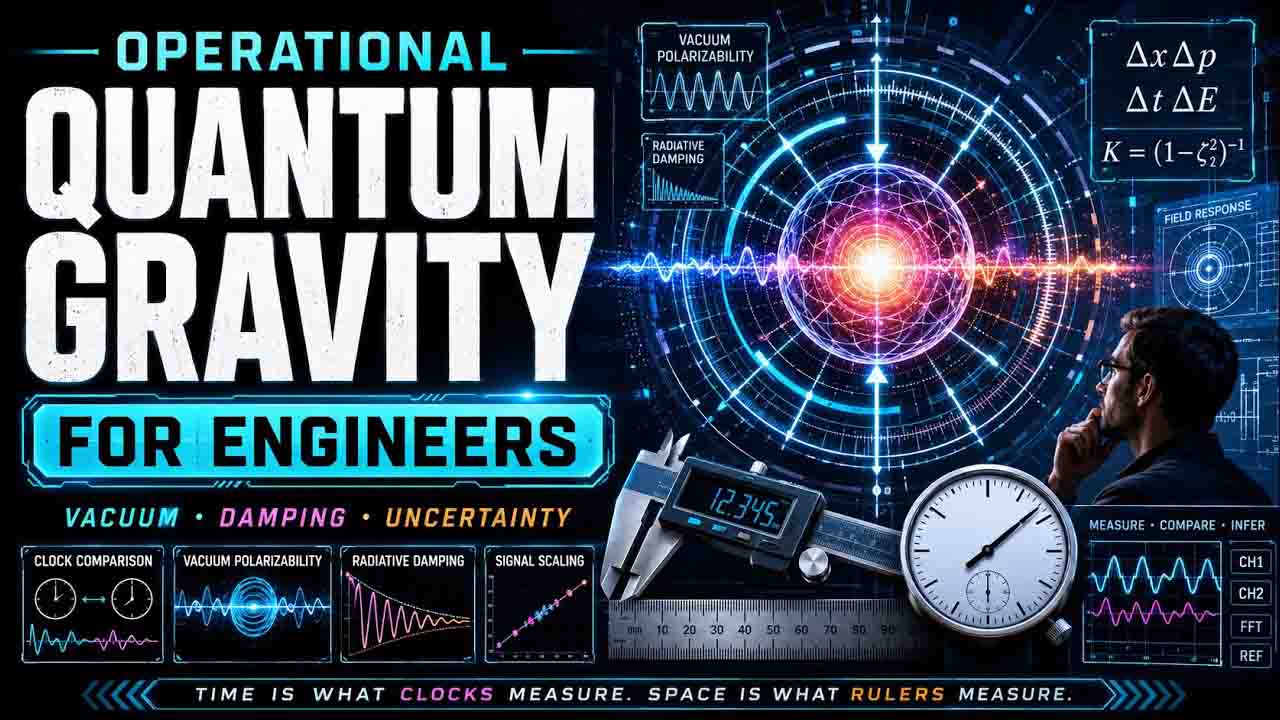
Todd Desiato’s Operational Quantum Gravity For Engineers
Todd Desiato isn't asking you to abandon Einstein - just to imagine that the familiar bending of clocks and rulers may be the visible face of a deeper material process: matter settling into a different equilibrium with…

Spin, Gravity, and Mythology: Why Antigravity Keeps Going in Circles
Across the long history of legends about antigravity and breakthrough propulsion, spin appears with uncanny persistence—not merely as an engineering choice, but as a symbol of hidden order, stored force, and rebellion…

The Pope-Osborne Angular Momentum Synthesis Theory (POAMS)
The Pope-Osborne Angular Momentum Synthesis Theory (POAMS) explains gravitational and electrostatic behavior through angular momentum rather than through invisible field forces. Developed by Anthony D. Osborne and N.…

The Dineutron Engine: Energy and Propulsion from the Quantum Vacuum
The dineutron engine would be powerful, but it would not have a mighty roar. It would not glow like a reactor core, spit exhaust like a rocket, or hum like a turbine. It would hide inside the nucleus of an atom, where…

The Vacuum Propeller: The Pendulum Test That Challenges Known Physics
The phrase sounds impossible before the experiment even begins: a propeller for the vacuum. A propeller is a bargain with matter; it pushes air, water, plasma, anything with enough substance to push back. The vacuum is…

Heim Theory: Geometry, Propulsion, and the Physics Beyond Rockets
Heim Theory has spent decades at the edge of science—not because it lacked ambition, but because it asked for almost too much at once. Burkhard Heim wanted to move beyond the rocket equation, derive particle masses from…

Top 25 Challenges to the Second Law of Thermodynamics
The second law of thermodynamics is the law that says usable energy runs down: heat spreads, gradients fade, and no cyclic machine can turn ambient heat entirely back into work. Prof. Daniel P. Sheehan, Professor of…

Challenging the Second Law of Thermodynamics
In every warm room there is a hidden ocean of energy: air molecules racing at hundreds of meters per second, water trembling with molecular motion, walls and wires and bodies saturated with heat. The energy is real,…
Space-Time Is A Material
For more than a century, modern physics has treated space in two different ways at once. In one sense, space-time is the fabric on which gravity, motion, and causality depend; in another, it is still casually spoken of…

The GEM Effect: New Evidence for Electromagnetic Gravity Modification?
Dr. John Brandenburg reports that an electromagnetic device—a roughly 170‑gram coil taken from a miniature electric motor and driven with Tesla-style three‑phase AC—shows an apparent drop in weight of about 0.15 grams…