From vacuum batteries and spacecraft propulsion, researchers are learning how to engineering fluctuation-induced forces.
Can an interaction across an apparently empty gap become the working part of a machine? Casimir research has moved beyond measuring tiny attractions to controlling mechanical motion, assembling optical structures, and generating quantum-correlated radiation with external drives. Its more ambitious proposals reach toward vacuum-energy power cells and spacecraft propulsion. These 47 devices and concepts map that landscape — from measured laboratory effects to designs that remain theoretical or disputed — and reveal why understanding what powers a device is just as important as understanding the force it uses.
This catalogue brings together microscopic actuators, contactless mechanical transmissions, sensitive measuring instruments, self-assembling optical cavities, and circuits that generate quantum-correlated photons. It also includes proposals for vacuum-energy batteries, electrical power cells, and propulsion systems. These are not all the same kind of achievement. Some describe measured laboratory effects; others are theoretical designs, patents, or experimental claims whose interpretation remains disputed. The entries below group related devices where appropriate and distinguish what was proposed, what was built, and what was measured. Throughout, one distinction matters: using a Casimir interaction to control or transfer energy is not automatically the same as obtaining usable energy from the quantum vacuum.
Energy: Batteries, Power Cells, and Heat Transfer
Energy-related Casimir devices span several different functions. Some would store or convert energy, some transport heat, and others explicitly seek to extract power from vacuum fluctuations.
1. Forward’s Vacuum-Fluctuation Battery
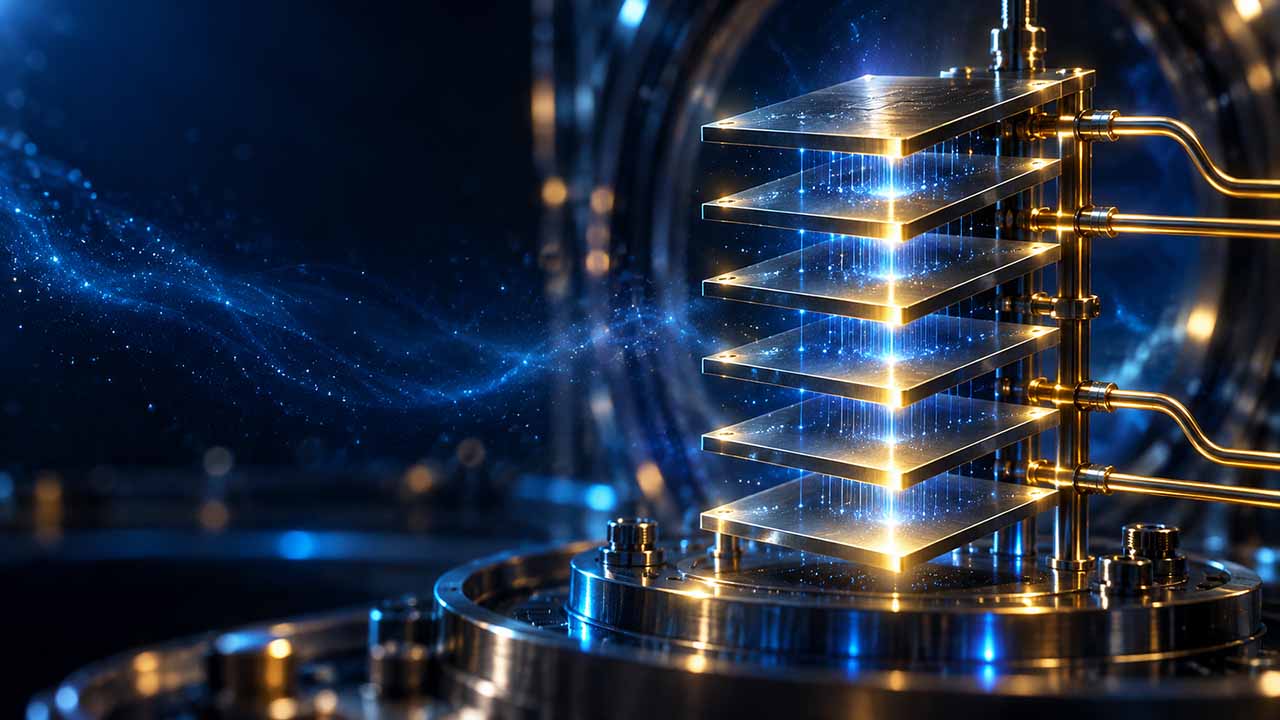
Theoretical proposal. Robert Forward imagined a battery built from closely spaced, electrically charged conducting leaves. Casimir attraction would draw the leaves together, doing work against their electrostatic repulsion and increasing the electrical energy stored in the arrangement. The concept makes the force part of an energy-conversion mechanism rather than merely something to measure. Its contraction phase, however, is only part of the story: separating the leaves and restoring the starting configuration requires recharge work. Paper:Extracting electrical energy from the vacuum by cohesion of charged foliated conductors (1984)
2. Forward’s Variable-Geometry Casimir Cavity
Theoretical proposal. Forward also explored whether changing a rectangular cavity’s dimensions through a carefully chosen sequence could yield useful work. Instead of bringing two plates straight together, the proposal follows a path through several cavity shapes, exploiting the way Casimir energy depends on geometry. Its provocative claim concerns the complete cycle: whether the apparent gains survive a full accounting of every deformation and the work needed to return the cavity to its original state. Paper:Apparent Endless Extraction of Energy from the Vacuum by Cyclic Manipulation of Casimir Cavity Dimensions (1999)
Theoretical proposal. Fabrizio Pinto proposed using light to change the electronic properties of semiconductor surfaces and thereby modify their Casimir attraction. Combining this optical control with mechanical movement produces a proposed engine cycle in which the interaction differs between stages. The design introduces an important engineering idea: controlling a fluctuation-induced force without relying exclusively on moving the surfaces. Evaluating the proposed energy output requires including the illumination, mechanical motion, and restoration of the initial state. Paper:Engine cycle of an optically controlled vacuum energy transducer (1999)
4. Haisch–Moddel Gas-Through-Cavity Energy Extractor
Patent proposal. Bernard Haisch and Garret Moddel proposed sending gas through small Casimir cavities that would alter the electromagnetic environment experienced by its atoms. Their proposed extraction cycle connects cavity-modified atomic energy states with radiation emission, which could then be collected. Associated with the Jovion concept, the architecture replaces moving plates with flowing matter. The patent describes a proposed mechanism; it does not establish that the complete gas-flow system produces net power from vacuum fluctuations. Patent:Quantum vacuum energy extraction — US7379286B2 (2008)
Reported experiment. Olga Dmitriyeva and Garret Moddel brought the gas-through-cavity idea into the laboratory by passing gas through nanoporous membranes and monitoring the apparatus with an infrared-sensitive detector. Their paper reports radiation signals and examines possible explanations. The experiment is a concrete test arrangement related to the preceding patent, but detecting radiation does not by itself identify its energy source. That requires separating the proposed cavity effect from the other processes present in a flowing-gas system. Paper:Test of Zero-point Energy Emission from Gases Flowing Through Casimir Cavities (2012)
6. Moddel’s Optical-Cavity Tunnelling Device
Reported electrical experiment; disputed energy interpretation. This solid-state device places an optical cavity above a metal–insulator–metal tunnelling junction. Moddel and colleagues report electrical current that depends on the cavity configuration, without an externally applied voltage, and describe controls intended to identify measurement artifacts. The architecture is notable because it seeks an electrical effect without a mechanically cycling cavity. The reported current and the proposed vacuum-energy explanation remain separate questions requiring their own evidence. Paper:Optical-Cavity-Induced Current (2021)
7. Moddel’s Vacuum- and Plasmon-Fluctuation Device Families
Related patent architectures. These patents extend the solid-state approach through structures intended to modify quantum-vacuum or quantum-plasmon fluctuations near electronic transport elements. The common ambition is to turn a deliberately altered fluctuation environment into an electrical output. They belong to a related development program rather than automatically representing two independently validated generators. For understanding the hardware, the useful distinction is between their optical or plasmonic structures and the electronic components intended to collect the resulting response. Patents:US11133758B2 (2021); US11463026B2 (2022)
8. Harold “Sonny” White’s Casimir Power Cell
Patented architecture and developer claims. The Casimir power-cell design associated with Harold “Sonny” White places electrically isolated conductive structures inside conductive cavities. The patent proposes obtaining an electrical potential between those structures, with MicroSparc associated with the broader development family. It is a distinct approach to making a compact electrical device from engineered cavity boundaries. The patent provides an architectural disclosure, but patent issuance is not independent verification of continuous net vacuum-powered operation. Patent:Casimir power cell — US12302769B2 (2025)
9. Casimir-Mediated Heat-Transfer Membranes
Experimental. Two mechanically compliant membranes exchange thermal energy across a vacuum gap through fluctuation-mediated coupling. Their interaction provides a route for transferring energy associated with mechanical vibrations without a material bridge between the membranes. This places Casimir-related physics in the realm of thermal engineering rather than speculative power generation. The central achievement is transporting heat between bodies, not creating heat or electricity without an energy source. Paper:Phonon heat transfer across a vacuum through quantum fluctuations (2019)
Motion: Propulsion, Contactless Gears, Torque, and Repulsion
Casimir interactions can do more than pull surfaces together. Researchers have explored lateral forces, rotational coupling, repulsion, and the possibility of producing thrust.
10. Maclay–Forward Dynamical-Casimir Spacecraft
Theoretical proposal. G. Jordan Maclay and Robert Forward considered a spacecraft that would produce radiation through the dynamical Casimir effect and recoil as the emitted photons carry momentum away. The proposed mechanism relies on rapidly driven reflecting boundaries rather than conventional propellant. Its central engineering challenges are the boundary motion, required drive energy, and resulting thrust. It is a radiation-reaction concept — not a demonstration of reactionless propulsion or thrust without an energy input. Paper:A Gedanken Spacecraft that Operates Using the Quantum Vacuum (Dynamic Casimir Effect) (2004)
11. Pinto’s Dispersion-Force Propulsion Apparatus
Patent proposal. Pinto’s propulsion patent combines trapped particles, electromagnetic excitation, and a piston or mechanical element to exploit modified dispersion-force interactions. It is not simply a pair of asymmetric Casimir plates. The proposed force-producing mechanism depends on the relationship between particles, optical excitation, and mechanical motion. Understanding the design therefore requires following the complete particle-based cycle rather than treating every vacuum-related propulsion proposal as the same kind of thruster. Patent:Apparatus comprising of propulsion system — US20060027709A1 (2006)
12. DeBiase’s Wedge and Mirror-Grating Concepts
Speculative theoretical proposals. Robert DeBiase explored whether wedge-shaped cavities, nonparallel surfaces, and mirror-grating arrangements could produce asymmetric Casimir-force components. His work asks whether particular geometries reveal behavior missed by simpler approximations and whether the calculated forces remain conservative. These are questions about force calculations and complete-system behavior, not an established propulsion result. A directional force on one component must still be distinguished from a net force on the entire apparatus. Paper:Are Casimir Forces Conservative? (2012)
13. Ludwig’s Grooved-Sphere and Sawtooth-Grating Apparatus
Conference-reported exploratory hardware. Thorsten Ludwig’s apparatus uses structured surfaces, including sawtooth corrugations and selectively metallized grooves, to investigate asymmetric interactions. Placing such features on a sphere allows them to be studied opposite a flat surface using sensitive force-measurement methods. His presentation describes attempts to detect lateral effects and other motion-related signals. The work documents exploratory hardware, but not a validated whole-device propulsion result; the relevant source here is a conference presentation rather than a corresponding journal paper. Presentation:Zero-Point Energy Harvesting and Casimir-Effect Spheres — Thorsten Ludwig, APEC (2026)
14. Fateev’s Casimir-Expulsion Cavities and Quantum Motors
Theoretical proposals. Evgeny Fateev investigated asymmetric open cavities and related periodic or shifted configurations that his calculations associate with a Casimir “expulsion” force. The proposed applications extend toward motors and propulsion. Their significance rests on whether the predicted behavior survives complete-system accounting, including all relevant surfaces and stresses. The cited work presents a mathematical proposal, not an operating motor or a calibrated demonstration of net thrust. Paper:Casimir force of expulsion (2012)
15. Noncontact Casimir Rack-and-Pinion Gears
Theoretical mechanical transmission. Imagine a rack and pinion whose teeth never touch. In this proposal, a corrugated rack interacts with a corrugated cylindrical pinion through the lateral Casimir force, allowing motion to be transmitted across a narrow gap. Related designs examine the rectification of imposed motion. The appealing engineering feature is contactless coupling: the Casimir interaction would replace direct tooth contact, while the energy still comes from whatever drives the mechanism. Paper:Noncontact Rack and Pinion Powered by the Lateral Casimir Force (2007)
Experimental. Casimir interactions can produce a twisting tendency as well as a straight-line force. In this experiment, a birefringent solid interacts with a liquid crystal across a small separation, creating an alignment torque. The researchers measured its dependence on angle and distance and controlled its behavior through material selection. The result provides an experimental foundation for considering Casimir-based rotational alignment and other nanoscale mechanisms in which orientation matters as much as spacing. Paper:Measurement of the Casimir torque (2018)
17. Casimir-Torque Nanoparticle Chains
Theoretical. Closely spaced rotating nanoparticles can, in the studied models, exchange angular momentum through electromagnetic fluctuation-induced torques. Arranged in chains, they exhibit collective rotational behavior that suggests possible synchronization and contactless transmission functions. Rather than meshing physical gears, the particles would communicate rotational motion through their interactions. The cited research analyzes those dynamics; it does not report a fabricated chain operating as a practical mechanical transmission. Paper:Nanoscale transfer of angular momentum mediated by the Casimir torque (2019)
18. Repulsive Casimir–Lifshitz Platforms
Experimentally measured repulsion. Casimir-related interactions need not always be attractive. With appropriately selected dissimilar materials separated by a liquid, the force can become repulsive. Munday, Capasso, and Parsegian measured such an interaction, establishing an important possibility for reducing unwanted attraction between nearby surfaces. Repulsion also motivates ideas for suspension and low-contact mechanisms, but a measured repulsive force should not be confused with a complete stable bearing or levitated machine. Paper:Measured long-range repulsive Casimir–Lifshitz forces (2009)
19. Chernodub’s Rotating Casimir Rings and Nanotubes
Theoretical. These models examine ring-like systems in which a magnetic field changes the relationship between rotation and Casimir energy. The proposed possibilities include rotationally favored states and potential realizations involving doped nanotubes. The paper’s language is deliberately provocative, but its subject is a theoretical ground-state and thermodynamic problem — not a demonstrated power-producing motor. Even where persistent rotation is proposed, that does not by itself establish continuously extractable useful work. Paper:Rotating Casimir systems: Magnetic-field-enhanced perpetual motion, possible realization in doped nanotubes, and laws of thermodynamics (2013)
Force Control: Actuators, Chips, and Tunable Materials
A practical route into Casimir engineering is to make the force adjustable. These devices explore control through motion, geometry, illumination, electrical gating, and material changes.
20. Bell Labs’ Casimir Micromechanical Actuator
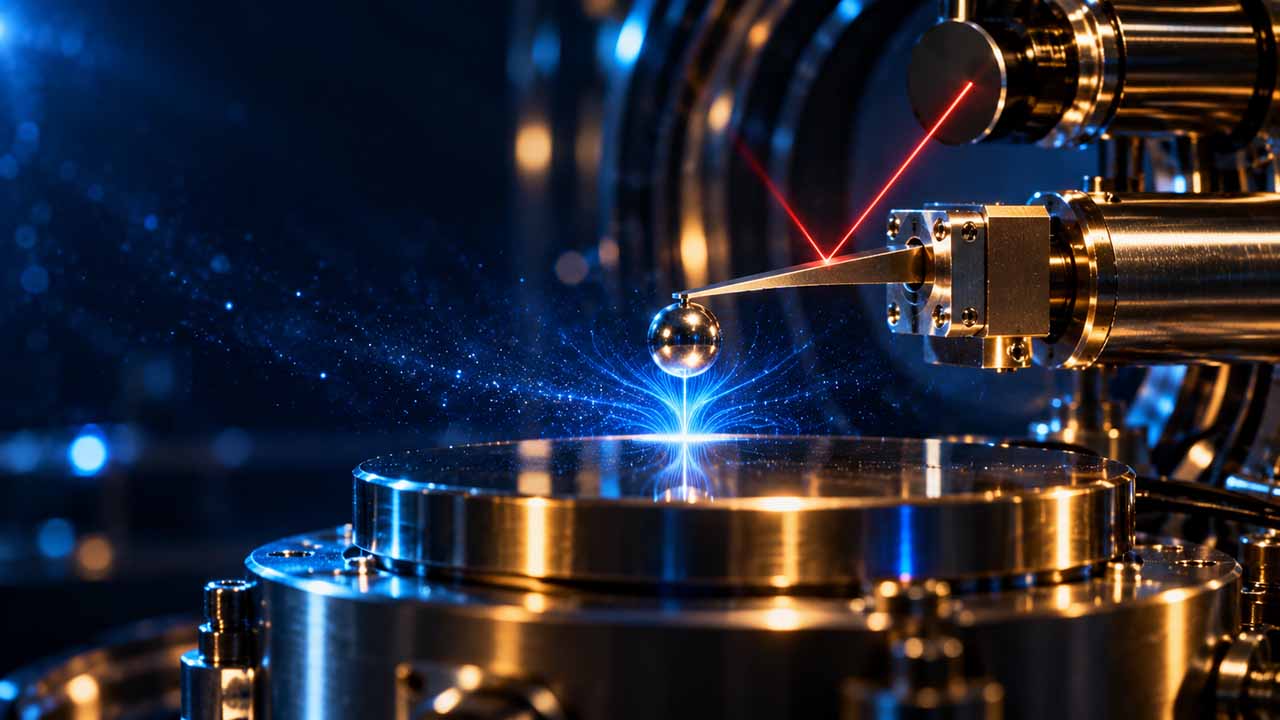
Experimental. A metallic sphere positioned near a tiny suspended torsional plate attracts it strongly enough to produce a measurable rotation. Chan and colleagues used this arrangement to show that the Casimir force could actuate a fabricated microelectromechanical system, or MEMS device. The experiment turns a force often associated with unwanted adhesion into an intentional mechanical function: a nearby surface becomes part of an actuator. Paper:Quantum Mechanical Actuation of Microelectromechanical Systems by the Casimir Force (2001)
21. Bell Labs’ Nonlinear Casimir Oscillator
Experimental; related to the preceding actuator. An externally driven micromechanical oscillator operates close enough to another surface that the Casimir interaction changes its mechanical response. The experiment exhibits nonlinear resonance behavior and hysteresis, making it relevant to proposed switching functions. The important shift is from using the interaction to produce a static deflection to using it to shape an oscillator’s dynamics. The oscillation itself still receives energy from an external drive. Paper:Nonlinear Micromechanical Casimir Oscillator (2001)
22. Integrated Silicon Casimir Chips
Experimental. Lithographically fabricated silicon structures combine an actuator and a force-sensitive mechanical element on the same chip. This integration allows nearby surfaces to be positioned and measured without assembling the experiment entirely from separate macroscopic components. It also opens the door to more elaborate geometries that can be fabricated together. The device is both a measurement platform and a demonstration that Casimir experiments can be built into integrated micromechanical hardware. Paper:Casimir forces on a silicon micromechanical chip (2013)
23. Interlocking Silicon Nanostructures
Experimental. These specially shaped, interlocking structures produce a Casimir-force response that varies non-monotonically with displacement. Instead of following the simple intuition that bringing two flat surfaces closer always increases their attraction in the same way, the geometry changes how the interaction evolves. The experiment demonstrates that shape can engineer force gradients and mechanical stiffness. Its significance is controlled internal mechanics, not propulsion of the complete chip. Paper:Measurement of non-monotonic Casimir forces between silicon nanostructures (2017)
24. Three-Dimensional Pillar and Hollow-Cylinder Arrays
Experimental. A sphere interacts with fabricated three-dimensional structures, including pillars, hollow cylinders, and arrays. These geometries alter the force compared with simpler surface arrangements, demonstrating substantial control through physical shape. The work is especially relevant to device design because it treats the interacting region as something engineers can sculpt. Rather than relying only on a different coating or material, it changes the structure of the surfaces themselves. Paper:Casimir Force Control Enabled by 3D Nanostructures (2025)
25. Optically Modulated Silicon Force Devices
Experimental. Laser illumination changes the population of charge carriers in silicon, modifying its dispersion-force interaction with a nearby metallic sphere. The experiment demonstrates active force control using light as an input. It is an important counterpart to optically controlled engine proposals because the measured achievement is specific: illumination changes the force. That capability can motivate switches and actuators without requiring a claim that the device generates its own operating energy. Paper:Demonstration of optically modulated dispersion forces (2007)
26. Phase-Change-Material Casimir Switches
Experimental force contrast. Phase-change materials have different optical properties in their amorphous and crystalline states. Studies involving materials such as AIST show that these changes also alter the Casimir interaction. This suggests a way to select different force states by changing the material rather than continuously repositioning the entire apparatus. The cited work establishes force contrast between phases; it should be distinguished from a packaged switching product with demonstrated endurance and system-level performance. Papers:Switching Casimir forces with phase-change materials (2010); Casimir Force Contrast Between Amorphous and Crystalline Phases of AIST (2012)
Theoretical. A metal–insulator–semiconductor structure uses electrical gating to alter the carrier concentration in a transparent conductive oxide. The resulting change in electromagnetic response is predicted to tune the Casimir force. This approach brings force control closer to the familiar language of electronic devices: a voltage becomes the control input. The cited paper calculates the proposed tunability rather than reporting a completed switch with measured performance. Paper:Electrically switchable Casimir forces using transparent conductive oxides (2022)
28. Graphene-Multilayer Force Modulators
Theoretical and numerical. Graphene and dielectric layers are arranged so that electrical doping, temperature, and layer configuration change the Casimir interaction. The calculations predict substantial control over the force, suggesting a materials platform for future sensors, switches, and actuators. The device concept is not simply “graphene harvesting vacuum energy.” Its studied function is tunability: using externally controlled material properties to change the interaction between nearby structures. Paper:Strong Thermal and Electrostatic Manipulation of the Casimir Force in Graphene Multilayers (2017)
29. Chiral-Metamaterial Repulsion Structures
Theoretical. Engineered materials with sufficiently strong electromagnetic chirality are modeled as producing repulsive Casimir interactions and possible equilibrium separations. The concept extends force engineering from the shape of a surface to its electromagnetic response. Its predictions depend on the assumed material properties, making physical realizability central to the proposal. The cited paper explores those possibilities mathematically rather than demonstrating a levitating metamaterial device. Paper:Repulsive Casimir Force in Chiral Metamaterials (2009)
Measurement: Force Sensors, Gravimeters, and Precision Resonators
Before a subtle interaction becomes useful engineering, it must be measured reliably. These platforms examine tiny forces, mechanical responses, and proposed sensing applications.
30. Ludwig’s AFM and Quartz-Tuning-Fork Sensors
Apparatus development and reported measurements. Ludwig’s sensor family uses atomic-force-microscope methods and quartz resonators to detect sphere–surface interactions. Small deflections or changes in resonator behavior provide a readout of force or force gradient. The instruments support investigations of geometry, materials, and possible sensing functions. Although the work uses “quantum field energy sensor” terminology, the direct observables are mechanical interactions — not an absolute measurement of vacuum-energy density. Papers:Casimir force experiments with quartz tuning forks and an atomic force microscope (AFM) (2008); Quantum Field Energy Sensor based on the Casimir Effect (2012)
Experimental reference hardware. Several apparatus families provided essential foundations for later Casimir engineering. They belong together as reference platforms, but their mechanical arrangements are distinct.
31a. Lamoreaux’s torsion pendulum. An electromechanical torsion balance measures attraction between closely spaced conducting surfaces. Its sensitive rotational response made it an important precision test of the interaction. Paper:Demonstration of the Casimir Force in the 0.6 to 6 μm Range (1997)
31b. Mohideen–Roy’s sphere–plane AFM. A metallized sphere attached to an atomic-force-microscope cantilever approaches a flat plate. The cantilever response allows force measurements at submicrometre separations. Paper:Precision Measurement of the Casimir Force from 0.1 to 0.9 μm (1998)
31c. Decca’s micromachined torsional oscillator. A gold-coated sphere interacts with a metal-coated torsional oscillator. Changes in the oscillator’s dynamics provide a sensitive means of measuring the force, including interactions between dissimilar metals. Paper:Measurement of the Casimir Force between Dissimilar Metals (2003)
31d. The Bressi–Carugno–Onofrio–Ruoso parallel-plate apparatus. A chromium-coated silicon cantilever faces a similarly coated rigid surface. Resonance-frequency shifts measure the interaction in a parallel-surface geometry rather than a sphere–plane arrangement. Paper:Measurement of the Casimir Force between Parallel Metallic Surfaces (2002)
32. Commercial-MEMS Casimir Metrology Platform
Experimental. A commercial MEMS accelerometer becomes a Casimir-force instrument when a microsphere is attached to its proof mass and positioned near an opposing plate. The accelerometer’s capacitive readout then detects the mechanical response to the interaction. This approach is notable for adapting existing sensor hardware rather than requiring every component to be purpose-built. It demonstrates a route toward more accessible experimental platforms, not a new kind of energy source. Paper:Building a Casimir metrology platform with a commercial MEMS sensor (2019)
33. Casimir-Driven Parametric Magnetic Gradiometer
Simulated design. This proposed MEMS instrument uses time-dependent Casimir coupling to amplify signals associated with weak spatial variations in magnetic fields. Its control strategy is designed to obtain amplification while avoiding destructive pull-in, where attraction causes nearby components to collapse together. The work connects Casimir engineering with magnetic sensing, but the reported sensitivity improvements come from simulations rather than a completed instrument demonstrating those capabilities. Paper:Analysis of a Casimir-driven Parametric Amplifier with Resilience to Casimir Pull-in for MEMS Single-Point Magnetic Gradiometry (2021)
34. Pinto’s Parametric Gravimeter and Accelerometer
Theoretical and numerical. A nanoelectromechanical oscillator receives electrostatic excitation while illumination changes the dispersion force from a nearby semiconductor boundary. The resulting modulation provides parametric amplification of acceleration-related signals. The proposal aims to turn a controllable surface interaction into a metrology tool, with applications in gravimetry and spacecraft measurements. Optical pumping and the oscillator’s other inputs are part of the sensing system, not incidental details outside its energy budget. Paper:Gravimetry by Nanoscale Parametric Amplifiers Driven by Radiation-Induced Dispersion Force Modulation (2022)
35. CANNEX: Casimir And Non-Newtonian Force EXperiment
Precision-apparatus design and development. CANNEX uses closely controlled parallel plates to investigate weak pressures and force gradients. Its design addresses vibration, thermal drift, electrostatic backgrounds, and the difficulty of maintaining the required geometry. The instrument is intended both for Casimir measurements and searches for additional short-range interactions. The linked publication presents the apparatus’s final design review and outlook rather than a commercial sensor specification. Paper:Force Metrology with Plane Parallel Plates: Final Design Review and Outlook (2024)
36. The Archimedes Vacuum-Energy-Weight Experiment
Proposed measurement and pathfinder development. Archimedes asks whether an ultrasensitive balance could detect a change in gravitational force when a sample’s Casimir energy is modulated. The proposed approach uses a superconducting transition to change the relevant electromagnetic properties. This is a gravity-related measurement program, not a propulsion device or gravity shield. The linked paper describes a pathfinder toward the measurement, not an accomplished weighing of vacuum energy. Paper:The Archimedes experiment (2015)
Reported experiment with a debated force interpretation. A metal-coated membrane couples to a narrow-gap microwave cavity, and the researchers attribute changes in its mechanical response and dissipation to a thermal Casimir spring. A later critique argues that the Casimir force is too weak to explain the observed attraction; the authors’ reply disputes the applicability of the critic’s approximation to their geometry. The apparatus therefore illustrates both a potential sensing mechanism and the importance of identifying the force responsible. Original paper:Casimir spring and dilution in macroscopic cavity optomechanics (2020). Published discussion:Inadequacy of the Casimir force for explaining a strong attractive force in a micrometre-sized narrow-gap re-entrant cavity (2025); Authors’ reply (2025)
38. Superconducting-Drum Casimir-Compatible Force Platform
Reported experiment; qualified force identification. A superconducting drum integrated into a microwave optomechanical cavity exhibits a strong nonlinear attractive interaction. The researchers find its magnitude compatible with the Casimir force for the expected vacuum separations in the device. The qualification is important: the paper presents a Casimir-compatible interpretation rather than removing every uncertainty in force identification. The platform provides a way to investigate strong nonlinear mechanics in closely spaced superconducting structures. Paper:Measurement of a strong nonlinear force between superconductors compatible with the Casimir force (2026)
Information: Mechanical Circuits, Optical Cavities, and Quantum Photons
Casimir-based components also offer ways to route mechanical signals, control optical behavior, and generate nonclassical radiation. These functions need not depend on vacuum-energy extraction.
39. Purdue’s Casimir Mechanical Diode
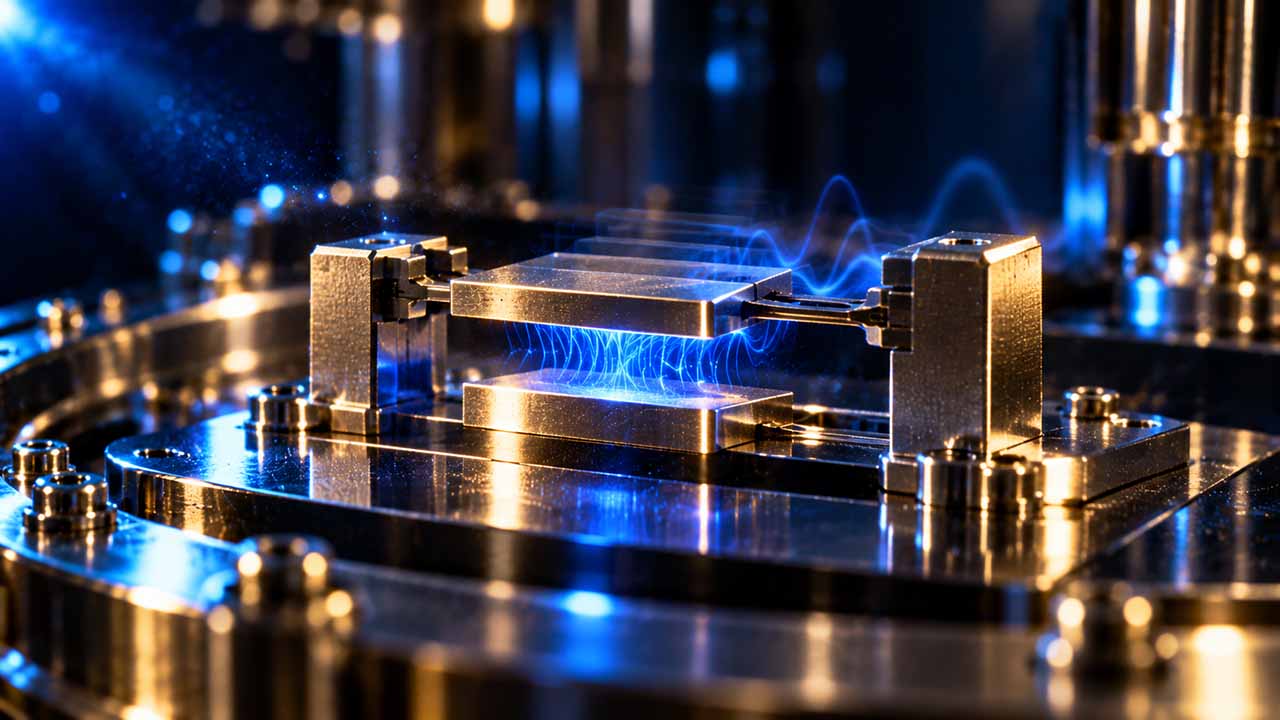
Experimental. Two micromechanical oscillators exchange energy through a parametrically modulated Casimir interaction. By controlling the modulation, researchers make the transfer direction-dependent, producing a mechanical analogue of a diode. The result is significant because it makes an interaction between nearby objects part of a controllable signal-routing system. It is an actively driven energy-transfer device, not a passive generator of electrical power. Paper:Non-reciprocal energy transfer through the Casimir effect (online 2021; journal volume 2022)
40. Purdue’s Three-Terminal Casimir Transistor
Experimental. A central plate sits between two microspheres, with all three elements attached to mechanical resonators. Modulating the central element controls energy transfer between the outer elements, while adding gain enables amplification. The architecture functions as a mechanical transistor analogue: a third component controls transmission through the system. Its switching and amplification belong to an actively controlled mechanical circuit, not a conventional electronic transistor or a self-powered amplifier. Paper:Observation and control of Casimir effects in a sphere-plate-sphere system (2022)
Theoretical. A sphere placed near an optical cavity’s movable mirror changes its mechanical behavior through the Casimir force. Calculations show that this can alter an optical-transparency window, providing a proposed way to control a probe beam. The device links a nanoscale mechanical interaction to an optical response. The cited study predicts switching behavior rather than reporting fabricated optical-switch hardware. Paper:Casimir switch: steering optical transparency with vacuum forces (2016)
42. Self-Assembled Casimir Optical Microcavities
Experimental. Metallic nanoflakes suspended in liquid form optical cavities when Casimir attraction balances electrostatic repulsion. The resulting structures can be tuned, and introducing an excitonic material produces hybrid light–matter states known as polaritons. This is a different kind of Casimir engineering: the interaction helps assemble and position the optical structure itself. The experiments demonstrate photonic components rather than a complete optical communications system. Paper:Tunable self-assembled Casimir microcavities and polaritons (2021)
43. CaSA Liquid-Interface Sensors
Experimental. Casimir self-assembly, or CaSA, turns related optical cavities into instruments for examining nanoscale surface interactions in liquids. Researchers analyze thermal motion and changing optical resonances to reconstruct interaction potentials and investigate properties such as surface charge and responses to ionic conditions. The cavity becomes both the object influenced by the forces and an optical means of reading them. It extends self-assembly from making structures to measuring their environment. Paper:Casimir self-assembly: A platform for measuring nanoscale surface interactions in liquids (2025)
Experimental. A superconducting quantum interference device, or SQUID, changes the effective electrical boundary of a superconducting transmission line when rapidly modulated by magnetic flux. Wilson and colleagues used this approach to observe microwave-photon generation and two-mode squeezing. No physical mirror needs to travel at relativistic speed; the circuit changes the electromagnetic boundary electronically. The drive supplies the emitted energy, while the dynamical Casimir process determines how that energy becomes quantum radiation. Paper:Observation of the dynamical Casimir effect in a superconducting circuit (2011)
Experimental. An array of superconducting elements forms a tunable microwave medium whose properties change under magnetic-flux modulation. The changing medium generates correlated microwave-photon pairs through a dynamical-Casimir process. Compared with a single modulated boundary, this design uses an engineered superconducting medium as the active structure. It is another demonstration of a pumped quantum-radiation source, with the modulation providing the energy. Paper:Dynamical Casimir effect in a Josephson metamaterial (2013)
46. Nonclassical and Entangled Microwave-Source Designs
Theoretical in the cited study. This work analyzes the quantum correlations and entanglement expected from a modulated superconducting waveguide, including the influence of thermal background noise. It develops the quantum-information implications of dynamical-Casimir sources rather than treating photon production alone as the final objective. The proposed value lies in the radiation’s correlations. A component capable of producing useful quantum states, however, is not automatically a demonstrated communication protocol or complete quantum processor. Paper:Nonclassical microwave radiation from the dynamical Casimir effect (2013)
47. Optomechanical Dynamical-Casimir Transducers
Theoretical architectures. These proposals connect mechanical motion with photon generation in strongly coupled optomechanical systems. One design incorporates a SQUID with a mechanically compliant arm inside a microwave cavity; related work treats a moving mirror quantum mechanically and predicts conversion of mechanical excitation into photons, including mirror–field entanglement. Their role is that of a proposed transducer between mechanical and electromagnetic behavior. The linked studies describe predicted architectures and dynamics rather than completed experimental converters. Papers:Ultrastrong optomechanics incorporating the dynamical Casimir effect (2016); Non-perturbative Dynamical Casimir Effect in Optomechanical Systems: Vacuum Casimir-Rabi Splittings (2017 preprint)
Closing Summary: From Subtle Forces to Useful Functions
Taken together, these 47 entries show that Casimir engineering is not one technology or one claim. It includes experimental actuators, precision force instruments, tunable interactions, mechanical energy-routing devices, self-assembled optical structures, and driven quantum-photon sources. Alongside them are proposals for batteries, power cells, motors, and propulsion systems that ask more ambitious questions about energy and momentum. The demonstrated achievements do not automatically validate those separate claims, but neither should the uncertainty surrounding a proposed power source obscure the measured functions of a sensor, actuator, or optical component. Each device deserves to be understood according to its mechanism, inputs, measurements, and intended use.
The useful question is therefore not simply whether a machine “uses the vacuum.” It is what the machine actually does: what was built, what was measured, where the energy entered, and how forces or momentum were exchanged. Those questions make it possible to remain open to unconventional ideas without confusing possibility with performance. The strongest story in this catalogue is the progression from detecting subtle interactions to deliberately shaping them — and, in a growing variety of experiments, building devices around them.